5 Ways to Lower Your Experience Modification Rate in 2026
Understanding Your Experience Modification Rate
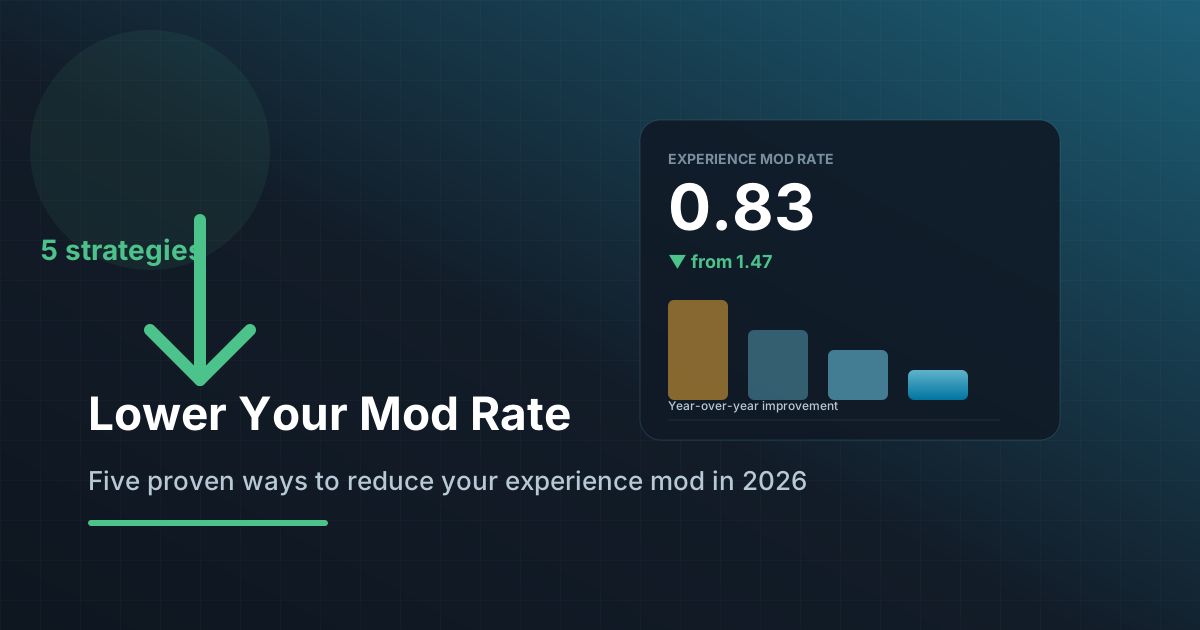
Your experience modification rate — commonly called your mod rate or EMR — is a multiplier applied to your workers compensation premium. A mod rate of 1.0 means you are paying the average premium for your industry and size. Above 1.0, you are paying more. Below 1.0, you are paying less.
The calculation is based on a three-year rolling window of your claims history, excluding the most recent policy year. Your actual losses (claim payments) and expected losses (industry average for your classification and payroll) are compared, and the result determines whether your premium goes up or down.
For a business paying $200,000 in base premium, the difference between a 1.2 mod rate and a 0.85 mod rate is $70,000 per year. Over the three-year rating period, that is $210,000. This is why your mod rate deserves as much attention as any other line item on your P&L.
Here are five proven strategies to lower your mod rate in 2026 and beyond.
1. Implement Medical Direction on Every Claim
Medical Direction is the single most effective mod rate reduction strategy available. By directing injured employees to vetted occupational medicine providers instead of emergency rooms, you accomplish several things simultaneously:
- Lower medical costs — Occupational medicine clinics treat workplace injuries for a fraction of ER costs, with better outcomes.
- Faster recovery — Occupational medicine physicians focus on functional recovery, not just symptom treatment.
- Controlled treatment plans — Every treatment plan is reviewed and managed to prevent unnecessary procedures and referrals.
- Shorter claim duration — Active management closes claims faster, which means less paid loss on your mod rate worksheet.
Companies that implement Medical Direction through our partnership with Industrial MD routinely see their mod rate begin declining within the first full rating year.
2. Audit Your Mod Rate Worksheet for Errors
Your experience modification rate is calculated by the rating bureau — NCCI in most states, or the state bureau in monopolistic states. And like any complex calculation, errors happen. Common errors include:
- Claims attributed to the wrong policy period
- Closed claims still showing open reserves
- Incorrect classification codes applied to your payroll
- Medical-only claims not receiving the proper discount (in most states, medical-only claims are discounted by 70% in the mod calculation)
- Subrogation recoveries not reflected on the worksheet
We offer a complimentary Ex Mod review that audits your worksheet line by line. In many cases, we find errors that result in immediate mod rate corrections — and premium refunds for overpayments made in previous years.
3. Build a Structured Return-to-Work Program
Indemnity costs — the wage replacement benefits paid to injured employees while they are off work — are one of the most heavily weighted factors in your mod rate calculation. Every week an employee stays out of work adds to your indemnity exposure.
A structured return-to-work program reduces indemnity costs by bringing injured employees back to productive work as quickly as medically appropriate. This does not mean pushing injured workers back before they are ready. It means having a plan in place that includes:
- Light-duty positions — Modified roles that accommodate medical restrictions while keeping the employee at work.
- Transitional work plans — Graduated return to full duty with clear milestones and physician communication.
- Supervisor training — Managers who understand how to assign modified work and communicate with injured employees.
A well-run return-to-work program can reduce indemnity costs by 30-50%, which directly translates to mod rate improvement. Learn more about our Ex Mod Reduction Program.
4. Challenge Carrier Reserves on Open Claims
Here is something most employers do not realize: open reserves on your workers comp claims are included in your mod rate calculation, even if those reserves are never paid out. Insurance carriers set reserves conservatively — they estimate the worst-case scenario for every open claim. If a claim is reserved at $50,000 but ultimately settles for $15,000, your mod rate was inflated by the excess reserve for as long as that claim stayed open.
This is why active claims oversight is critical. We monitor every open claim, track treatment progress, and aggressively challenge inflated reserves when the claims trajectory supports a lower number. This is not adversarial — it is accountability. Carriers should reserve accurately, and when claim conditions improve, reserves should come down.
We have seen cases where a single reserve reduction of $20,000 to $30,000 produced a measurable mod rate improvement in the next rating period. Across multiple open claims, the cumulative impact can be substantial.
5. Invest in Loss Prevention and Safety Programs
The most powerful long-term mod rate strategy is also the simplest: prevent injuries from happening in the first place. No claim means no claim cost, no reserve, and no impact on your mod rate. Prevention is the cleanest win available.
Effective loss prevention programs include:
- Job hazard analyses — Systematic identification of hazards for each job function, with documented controls.
- New hire orientation programs — New employees are injured at three to five times the rate of experienced workers. Thorough safety orientation is critical.
- Regular safety training — Ongoing training keeps safety awareness high and reinforces proper procedures.
- Incident investigation protocols — Every near-miss and minor incident should be investigated to prevent escalation.
- Safety committee engagement — Involving employees in safety decisions increases buy-in and program effectiveness.
Industries with the highest injury frequency — construction, manufacturing, oil and gas, and restaurants — benefit the most from structured loss prevention programs.
Putting It All Together
Lowering your experience modification rate is not a one-time project — it is an ongoing discipline. The five strategies above work together as a system:
- Medical Direction controls claim costs when injuries occur.
- Mod rate audits catch errors that inflate your rate unfairly.
- Return-to-work programs reduce indemnity exposure.
- Reserve management keeps carrier estimates honest.
- Loss prevention reduces claim frequency at the source.
When all five are working in coordination, the results are predictable and significant. We have helped employers bring their mod rates from above 1.5 down below 1.0 — saving tens of thousands of dollars in annual premium.
Ready to start? Request your free Ex Mod review and find out exactly where your mod rate stands and what it would take to bring it down. Or contact us to learn more about building a comprehensive risk management program for your business.
Get a Free Workers Comp Quote
See how Medical Direction can lower your mod rate and reduce your workers comp costs.
Get Your Free Quote